 |
 |
| |
Dear colleagues,
The year could not have started better – with very compelling and positive results from the Alliance-sponsored AUGUSTUS trial.
Speaking to a packed auditorium at the AUGUSTUS late-breaker presentation at ACC in New Orleans, Principal Investigator Renato Lopes shared the data with an excited global audience.
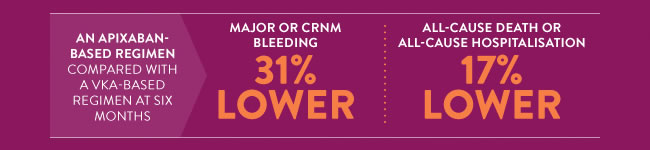
AUGUSTUS, a safety study without a primary efficacy endpoint, showed that in patients with NVAF and a recent ACS and/or undergoing PCI treated with a P2Y12 inhibitor with or without aspirin, at six months, the rate of bleeding was 31% lower with an apixaban-based regimen compared with a VKA-based regimen at the apixaban dose approved for the reduction of stroke risk.* Furthermore, the rate of all-cause death and all-cause hospitalisation was 17% lower with the apixaban regimen compared with the VKA regimen. These findings reinforce the safety profile of apixaban in the largest study to date in this population of patients who are at high risk of bleeding.
|
|
|
|
 |
|
| |
Importantly for the medical community, AUGUSTUS also showed that the addition of aspirin to anticoagulation and P2Y12 inhibitor was associated with an almost two-fold increase in bleeding risk. Professor Lopes summarised the data: In patients with atrial
fibrillation and a recent ACS and/or PCI treated with a P2Y12 inhibitor, an antithrombotic
regimen that included apixaban, without aspirin, resulted in fewer occurrences of major or
CRNM bleeding; treatment with apixaban was superior to VKA for occurrence of the
composite of all-cause death or all-cause hospitalisation, although it failed to show
superiority for occurrence of the composite of all-cause death or ischaemic events. |
|
|
 |
 |
|
 |
|
| |
|
OUR DATA IN THE SPOTLIGHT |
|
|
| |
|
AUGUSTUS really hit the headlines: the ACC session was highlighted in the official
meeting coverage and daily round-ups, including in a video interview of Professor Lopes;
the story was also picked up by high-visibility websites such as Medscape and STAT news and by delegates on Twitter. The global ‘splash’ around AUGUSTUS was greatly
amplified by the simultaneous online publication of the primary paper in the New
England Journal of Medicine (Lopes RD, et al. NEJM 2019; doi: 10.1056/NEJMoa1817083) and through press releases by the Alliance, ACC and Duke Clinical Research
Institute. |
|
|
|
|
| |
|
BMS and Pfizer channels drove interest on Twitter with a series of social media posts,
leading to widespread engagement with the AUGUSTUS presentation and study results.
Notable tweets included those from the NEJM, ACC, FiercePharma reporter Carly
Felhand, Duke Medical School, Cardiology Today and from the cardiologist Dr Geoff
Barnes; since the ACC presentation, tweets about the presentation and study results
have exceeded 500 unique tweets and thousands of retweets. |
|
|
|
|
| |
|
Overall, the data were well received by the clinical community; indeed, in an interview
with Professor Lopes, Professor Peter Block, Atlanta, CA, USA, called AUGUSTUS
‘a game changer for the way we take care of patients’. |
|
|
|
|
|
|
|
| |
|
GLOBAL MEDICAL EDUCATION
FOR RAPID RESULTS SHARING |
|
|
| |
|
Just after the primary results presentation in New Orleans, the Alliance also held a
sponsored lunchtime Medical Education symposium at the concurrent EHRA congress
in Lisbon, Portugal. Using a remote setup, Professor Lopes delivered his AUGUSTUS
late-breaker presentation for a second time via a video link to a packed auditorium in
Lisbon – from a meeting room in New Orleans. |
|
|
|
|
|
|
|
|
|
|
|
| |
|
BUILDING ON OUR STRONG START TO 2019 |
|
|
|
|
 |
|
We can be very proud of the positive
impact the AUGUSTUS data will
undoubtedly have on patients’ lives
worldwide through informing decisions
made by clinicians.
This study is an outstanding example of
our scientific leadership in the field – and
we will continue to work to help optimise care and
address unmet medical needs in as many
patients with NVAF and VTE as possible. |
|
|
|
|
 |
 |
|
|
|


